

Why Choose Premium Intimate Wellness Products in 2026
Table of Contents
- The Cheap Stuff Is Costing You More Than You Think
- What Actually Makes Premium Intimate Wellness Products Different
- Body-Safe Intimate Wellness Materials: What Belongs Near Your Bits
- How to Choose Intimate Wellness Products Without Getting Played
- Best Practices for Intimate Product Maintenance
- The Physiology of Pleasure: Why Better Products Mean Better Orgasms
- Inclusive Wellness and Sustainability: The Premium Brands Getting It Right
- Conclusion: Your Body Deserves the Upgrade
- Frequently Asked Questions
Last Updated: September 13, 2026
The Cheap Stuff Is Costing You More Than You Think
That drugstore lube you grabbed in a panic? It's mostly glycerin, and glycerin feeds yeast. That mystery-material toy from a flash sale? It's porous, so it holds onto bacteria like a bad ex holds onto grudges. If you're wondering why choose premium intimate wellness products, start here: the budget aisle isn't saving you money, it's billing you later in irritation, replacements, and regret.
This guide from The Flirty Femme breaks down what separates premium intimate wellness from the bargain bin, so you can shop with your standards intact. Below, we'll cover materials, ingredients, maintenance, and the physiology behind why better gear genuinely feels better.
What Actually Makes Premium Intimate Wellness Products Different
Premium means the ingredients and materials are disclosed, tested, and chosen for bodies, not for the lowest possible production cost. That's the whole difference.
Ingredient Transparency: Read the Label or Regret It
A common mistake is assuming "gentle" or "natural" on a label means anything at all. Those words aren't regulated. What matters is a full ingredient list you can actually read, plus a stated pH and osmolality for anything going inside you. If a brand won't tell you what's in the bottle, that silence is your answer.
Clinical Standards and Consumer Safety
Reputable makers test for body compatibility and follow established consumer safety guidance. The FDA's guidance on personal lubricants and medical devices is a useful starting point for understanding what actually gets reviewed and what doesn't. Spoiler: not everything on the shelf is held to the same bar.
Body-Safe Intimate Wellness Materials: What Belongs Near Your Bits
Body-safe means the material is non-porous, non-toxic, and free of phthalates, and it can be fully cleaned without trapping bacteria. Medical-grade silicone, glass, and stainless steel clear that bar. TPE, TPR, and jelly rubber generally don't. That's the short version. Here's the version that actually explains why, because "trust us" is not a materials spec.
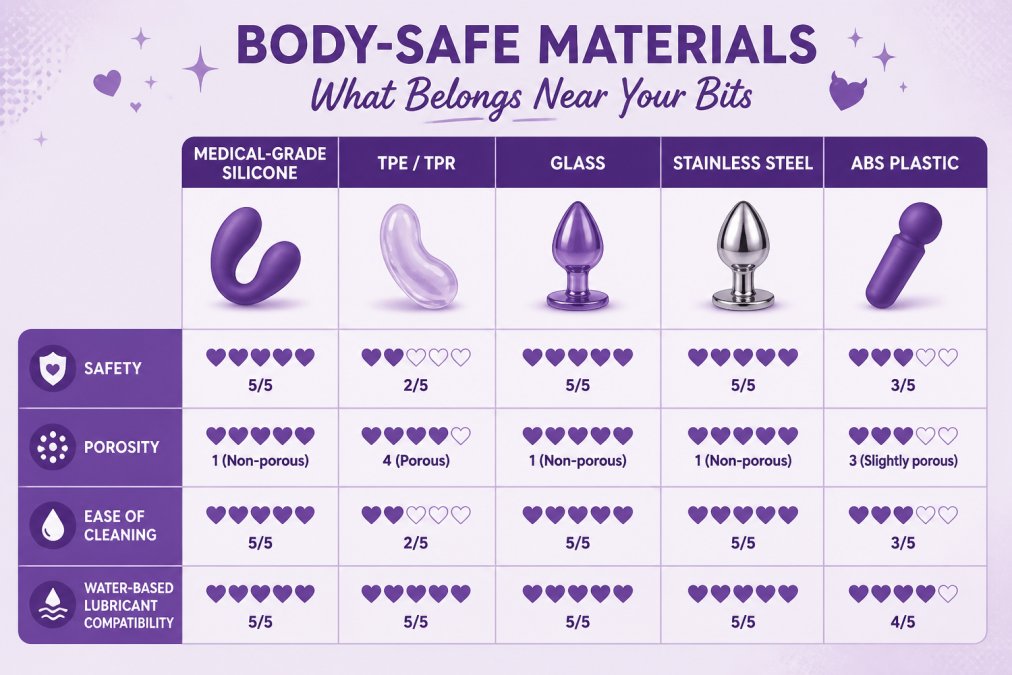
The Chemistry, Not the Marketing
Phthalates are plasticizers, chemicals added to soften hard plastics so they bend instead of crack. They're the reason a jelly toy feels squishy and a cheap one smells like a new shower curtain. The problem: phthalates aren't chemically bonded to the plastic, so they leach out over time, and mucous membranes absorb them far more readily than intact skin does. That's the mechanism behind the "body-safe" concern, not a vibe, a migration pathway.
Porosity is the other half. Non-porous materials have a surface so tight that bacteria and yeast have nowhere to hide. Porous materials, TPE, TPR, jelly rubber, and most "realistic feel" blends, are full of microscopic channels. You can wash the surface, but you can't sterilize the inside. A porous toy used during a yeast infection can harbor the organism and reintroduce it later, which is why practitioners consistently flag shared or infection-adjacent porous toys as a reinfection risk.
Shore Hardness and Why It Matters More Than You Think
Silicone isn't one thing. It's rated on the Shore A hardness scale, and that number changes everything about how a product feels and functions. A low Shore A (think soft, squishy, close to skin) is great for external use and gentle insertion. A higher Shore A (firm, structured) is what you want for anything that needs to hold a shape or apply targeted pressure. Premium makers publish this. Budget makers don't, because "firm" and "soft" are feelings, not specifications.
Thermal Limits and the Dishwasher Question
Medical-grade silicone, borosilicate glass, and 316 stainless steel can typically be boiled or run through a dishwasher's sanitize cycle. That's not a flex, it's the practical difference between a product you can fully reset and one you can only surface-clean. TPE and TPR will warp, degrade, or break down under that kind of heat, which is a quiet admission that they can't take real sterilization.
Medical-Grade Silicone vs. Mystery Rubber
Medical-grade silicone is hypoallergenic, non-porous, and heat-safe, which is why it costs more. Mystery rubber is porous, so it harbors bacteria no matter how well you wash it, and it often contains phthalates you don't want near mucous membranes. The price gap isn't marketing. It's chemistry.
The Label Words That Mean Nothing
"Body-safe," "medical-grade," and "hypoallergenic" are not regulated terms on intimate products the way they are in some other categories. A brand can print them on a box with zero testing behind them. What you can verify: a stated material ("100% medical-grade silicone," not "silky silicone blend"), a Shore A rating if it's silicone, and a full ingredient list on anything liquid. If a listing is vague about material, that vagueness is the answer.
How to Choose Intimate Wellness Products Without Getting Played
Answer the material question first, then the ingredient question, then the reviews question. Most buyers do it backwards and end up with something that looks cute and irritates everything.
Here's the order that actually works:
- Check the material: medical-grade silicone, glass, or stainless steel for anything insertable
- Read the full ingredient list on lubes and topicals, not just the front label
- Confirm pH and osmolality if it's going inside you
- Look for real reviews mentioning sensitive skin, not just star counts
- Buy from a retailer that discloses sourcing and stands behind returns
That last point matters more than people admit. A retailer with a real return policy is telling you they expect you to be satisfied, not stuck. The Flirty Femme stocks body-safe, pH-balanced options like water-based lubricants and intimate skincare, all vetted for exactly these criteria.

Best Practices for Intimate Product Maintenance
Clean before and after every use, and match your cleaner to your material. Silicone, glass, and steel tolerate warm water and mild soap or a dedicated toy cleaner. Electronics need spot cleaning around the motor housing, never a full soak.
Storage is the step everyone skips. Keep toys in separate pouches so silicone doesn't melt against other silicone, and store them away from direct sunlight and heat. Water-based lubricant pairs with everything; silicone-based lube degrades silicone toys, so keep them apart. Replace anything that develops a tacky texture or a smell that won't wash out, because that's the material breaking down.
The Physiology of Pleasure: Why Better Products Mean Better Orgasms
Better products mean better orgasms because arousal depends on friction, moisture, and circulation working together, and cheap products sabotage all three. But the interesting part isn't the slogan, it's the mechanism. Once you understand what's actually happening at the tissue level, "premium" stops sounding like a marketing word and starts sounding like a spec sheet.
Osmolality: The Number Nobody Talks About
Osmolality measures how concentrated a fluid is relative to your body's own fluids. Your vaginal mucosa is delicate, and it sits in an environment with a specific salt and water balance. A lubricant with very high osmolality pulls water out of those cells through osmosis, which is a documented mechanism behind the burning, stinging, and irritation people report from certain lubes (PubMed). A lubricant formulated to be closer to physiological osmolality doesn't fight your tissue, it works with it. Most budget lubes don't publish this number. Premium ones increasingly do, and that's not a coincidence.
pH: The Balance Your Body Maintains (And Cheap Products Wreck)
A healthy vaginal pH sits in the acidic range, roughly 3.8 to 4.5, and that acidity is a feature, it's part of how the body keeps unwanted organisms in check (peer-reviewed research). A lubricant or intimate product with the wrong pH can nudge that environment out of range, which is one reason glycerin-heavy and poorly formulated products get blamed for yeast issues. Glycerin is a sugar alcohol, and yeast loves sugar. That's the whole story behind the "glycerin feeds yeast" warning: it's not superstition, it's a food source.
The Friction-and-Nerve-Signaling Loop
Here's the part that makes the physiology click. Comfortable, well-lubricated stimulation lets blood flow and nerve signaling do their jobs without your body mounting a defense response. When something stings or drags, your nervous system reads it as threat, not pleasure, and arousal stalls, sometimes so subtly you don't consciously notice, you just feel "off." The pelvic floor can tense reflexively, which reduces blood flow, which reduces sensation, which makes the whole thing harder. Premium products remove that friction loop, literally and figuratively, so your body can stay in the response instead of the recoil.
Why "Feels Better" Isn't Just Marketing
A non-porous, properly shaped product glides instead of drags. A pH-balanced, low-osmolality lubricant supports the tissue instead of pulling from it. A design that actually matches anatomy delivers stimulation where the nerve endings are, rather than where a mold happened to land. None of that is luxury branding, it's the difference between a product engineered around physiology and one engineered around a price target.
Inclusive Wellness and Sustainability: The Premium Brands Getting It Right
The brands worth your money are designing for more bodies, not fewer. That means ergonomic shapes that work for different hand strengths and mobilities, adjustable settings, and products designed for solo use, partnered use, and everything between. Accessibility and disability-inclusive design are finally showing up in mainstream intimate wellness, and the brands doing it well are the ones earning loyalty.
Sustainability is the other differentiator. Rechargeable designs replace disposable batteries, medical-grade silicone outlasts porous alternatives by years, and refillable or recyclable packaging cuts waste. A toy you keep for five years is a greener purchase than five cheap ones you replace annually, and it's a better experience every time.
Conclusion: Your Body Deserves the Upgrade
The tricky part is that cheap products don't announce their flaws at checkout. They wait until you're mid-moment, irritated, and Googling "why does this burn." Choosing better means reading labels, checking materials, and buying from someone who actually vets the shelf.
The Flirty Femme curates body-safe, TikTok-trending intimate wellness products with full ingredient transparency, from pH-balanced water-based lubricants to intimate skincare and daily supplements. Discreet shipping, money-saving bundles, and a selection built around real standards rather than flashy packaging. Shop All and give your body the upgrade it's been asking for.
Frequently Asked Questions
Are premium intimate wellness products safer for sensitive skin?
Premium products are far more likely to use hypoallergenic, non-toxic materials like medical-grade silicone and pH-balanced formulas. Cheap alternatives often contain phthalates, parabens, and mystery plastics that can trigger irritation or allergic reactions. If your skin stages a rebellion every time you try something new, the problem might not be you. It's probably the product. Look for brands that list every ingredient and use body-safe materials tested to clinical standards.
What makes an intimate wellness product actually 'premium'?
Premium isn't just a fancy label. It means body-safe materials like medical-grade silicone, transparent ingredient lists, ergonomic design, and third-party safety testing. Premium products also tend to last longer, clean more easily, and feel better in use. A $30 water-based lubricant with pH-balanced, low-osmolality formulas outperforms a $5 drugstore option that dries out in minutes. You're paying for safety, comfort, and performance, not just packaging.
Do high-quality intimate products actually improve sexual health?
Yes, and the reasons are practical. pH-balanced lubricants protect intimate microflora and reduce irritation. Body-safe materials prevent bacterial buildup that porous toys harbor. Ergonomic designs reduce discomfort during use. Premium products also support hormonal health indirectly by reducing stress around intimacy. When your products work with your body instead of against it, sexual confidence and satisfaction tend to follow. It's not magic. It's just better engineering.
How do I know if an intimate wellness brand is reputable?
Check for three things: transparent ingredient lists, clear material specifications (medical-grade silicone, not just 'silicone'), and a return policy that doesn't make you feel like you're committing a crime. Reputable brands also avoid vague claims and instead cite clinical standards or third-party testing. If a brand won't tell you what's in the product or what it's made of, that's your answer. Walk away. Your body will thank you.