

Silicone vs Glass Toys for Beginners: A 2026 Guide
Table of Contents
- Silicone vs Glass Toys: The Comparison Table You Actually Need
- The Best Sex Toy Material for Beginners Comes Down to Three Questions
- Silicone Sex Toy Pros and Cons: The Squishy Crowd-Pleaser
- Glass Sex Toy Pros and Cons: The Firm, Fancy Option
- How to Clean Silicone Sex Toys (and Glass, While You're at It)
- Lube Compatibility, Temperature Play, and Other Things Nobody Tells First-Timers
- Your First-Purchase Checklist: Red Flags, Storage, and What to Skip
- Conclusion: Pick Your Material and Stop Spiraling
- Frequently Asked Questions
Last Updated: October 5, 2026
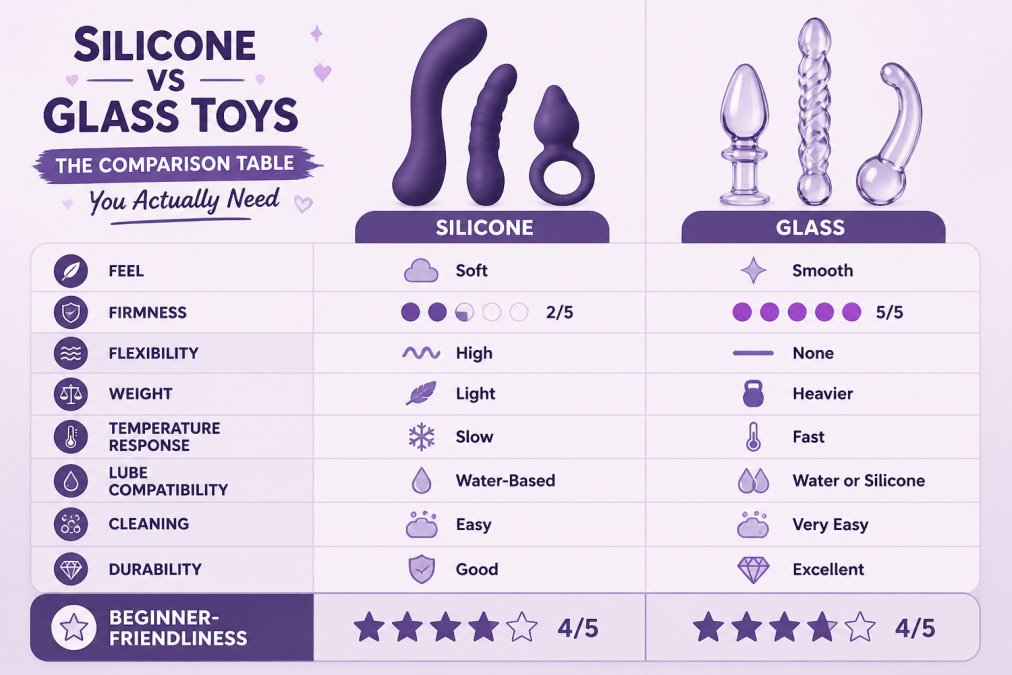
Silicone vs Glass Toys: The Comparison Table You Actually Need
Silicone vs glass toys for beginners is the debate that stalls more first purchases than anything else in the aisle. Here's the short version: silicone is soft, flexible, and forgiving; glass is firm, smooth, and responds to temperature. Both are body-safe, nonporous, and easy to clean.
The reason this decision feels so heavy is that it's your first one. Nobody wants to spend money on something that ends up in a drawer next to a dead vibrator and a half-used bottle of lube they hated. So let's make it simple.
| Feature | Silicone | Glass |
|---|---|---|
| Feel | Soft, squishy, flexible | Firm, smooth, rigid |
| Temperature | Warms to body temperature | Warms or chills on command |
| Lube | Water-based only | Water- or silicone-based |
| Cleaning | Soap and warm water | Soap and warm water |
| Breakage risk | None | Low, but chips if dropped |
| Beginner-friendly | Yes | Yes |
How to Read This Table Without Overthinking It
Don't scan for a winner. Scan for the row that made you go "oh, that one matters to me."
If you want something that bends with your body, silicone wins. If you want something that holds its shape and feels cool or warm against skin, glass wins. Everything else is maintenance, and maintenance is a preference, not a dealbreaker.
The Best Sex Toy Material for Beginners Comes Down to Three Questions
The best sex toy material for beginners depends on three things: whether you want soft or firm, whether you're playing solo or with a partner, and how much upkeep you're willing to do. Answer those honestly and the material picks itself.
Question 1: Do You Want Soft or Firm?
Silicone gives you softness, flexibility, and a little give. It's the material most people picture when they think "beginner-friendly," and for good reason: it moves with you instead of against you.
Glass gives you firmness and weight. That rigidity translates into pressure, which some people love and others find intense. Neither is better. They're just different sensations.
Question 2: Solo, Partnered, or Both?
Solo play tends to favor silicone because flexibility and suction bases make hands-free positioning easier. Partnered play can go either way, but glass holds up well for external stimulation and temperature games.
Question 3: How Much Maintenance Do You Want?
Both materials are nonporous and easy to clean. Glass is slightly lower maintenance because it doesn't attract lint the way silicone can. That's it. That's the whole maintenance gap.
Silicone Sex Toy Pros and Cons: The Squishy Crowd-Pleaser
Silicone sex toy pros and cons start with the obvious: it's soft, body-safe, and forgiving. Medical-grade, phthalate-free silicone is nonporous, so it doesn't harbor bacteria, and it warms to body temperature instead of fighting it.
The cons are real too. Silicone can't be used with silicone-based lube, which rules out the longest-lasting option. It also picks up lint and dust like a lint roller with a grudge, so storage matters more than you'd think. And cheaper "silicone" toys are often blends that aren't as body-safe as they claim.
How to Tell Real Silicone From a Blended Impostor
This is where beginners get burned. A toy labeled "silicone" might be a silicone blend, a TPR-silicone hybrid, or something with a fancy name and a mystery ingredient list. Here's how to check before you commit:
- The squeeze test. Real silicone springs back instantly and feels slightly tacky, not greasy. If it feels oily or leaves a residue on your fingers, walk away.
- The smell test. Real silicone has no smell. If it smells like plastic, chemicals, or a new-car interior, it's not pure silicone.
- The flame test (at home, on a sample). This one's for the curious: pure silicone won't melt or catch like plastic will. Don't do this on a toy you plan to keep, but it's a real way to tell.
- The label test. Look for "100% silicone," "medical-grade silicone," or "platinum-cure silicone." If it says "silicone blend," "jelly," or just "rubber," that's your answer.
The Lint Problem, Solved
Silicone attracts dust, hair, and lint the way a black sweater attracts cat fur. The fix is simple: store each toy in its own pouch or compartment. Not only does this keep it clean, it prevents silicone from bonding to other silicone if they sit against each other for long periods. A dedicated pouch is the cheapest insurance you'll ever buy for your toy.
Why Flexibility Matters for Beginners
Silicone's give isn't just a comfort feature, it's a usability feature. A flexible toy is easier to angle, easier to insert, and more forgiving if your body isn't in the mood to cooperate. If you have limited grip strength, dexterity issues, or you're just nervous, silicone's bend is a genuine advantage.
For a first purchase, our pick is the Cock-a-paloosa Silicone Dildo. It's made from medical-grade, phthalate-free silicone with 5 inches of insertable length, a strong suction base for hands-free play, and a flared base that works with most standard strap-on harnesses.

Glass Sex Toy Pros and Cons: The Firm, Fancy Option
Glass sex toy pros and cons come down to one word: firmness. Glass is rigid, smooth, and heavy in the hand, which makes it great for targeted pressure and temperature play. Chill it in the fridge or warm it under running water, and it holds that temperature far longer than silicone ever could. That's the party trick silicone can't touch.
The downside is the obvious one. Glass can chip or crack if you drop it, and a chipped toy is a retired toy. Quality matters here: look for annealed or borosilicate glass, which handles temperature shifts without shattering.
How to Inspect Glass Before and After Every Use
This is the part most guides gloss over, and it's the part that keeps you safe. Run a fingertip slowly along the entire surface, shaft, base, every curve. You're feeling for chips, hairline cracks, rough spots, or a seam you didn't notice before. Hold it up to a light and look through it. Bubbles or cloudy streaks inside the glass can signal a manufacturing flaw.
Handling Without the Butterfingers Moment
Glass gets slippery when lubed, so grip it firmly and keep both hands dry until you're in position. A towel within reach is your friend. If you're using it in the shower, reconsider, wet glass plus wet hands is a physics experiment you don't want to run. If you're clumsy (no judgment), silicone is the safer bet.
Cock-a-paloosa Silicone Dildo →
Storing Glass So It Survives the Drawer
Glass doesn't play well with others. Store it in a padded pouch or its own compartment, away from metal, hard plastic, or anything that could knock against it. Don't stack toys on top of it. Don't leave it on the edge of a counter. And never store it somewhere it can roll, a glass toy that hits tile is a glass toy that's done.
How to Clean Silicone Sex Toys (and Glass, While You're at It)
How to clean silicone sex toys: warm water, mild unscented soap, rinse, dry, done. Glass follows the same routine. Neither material is porous, so bacteria doesn't get a foothold the way it does with jelly or TPR toys.
A few things people get wrong:
- Skip antibacterial soap. It's harsh and unnecessary.
- Do clean before first use, not just after.
- Do store each toy separately so silicone doesn't fuse to other silicone.
For glass, inspect the surface before and after every use. Run a finger along the whole thing and feel for chips, cracks, or rough spots. If you find one, stop using it.
Lube Compatibility, Temperature Play, and Other Things Nobody Tells First-Timers
Lube compatibility is where most beginners get tripped up. Silicone toys need water-based lube, full stop. Silicone-based lube can degrade silicone toys over time, turning a smooth surface tacky and ruining the finish.
Glass is the easy one. It plays nicely with water-based and silicone-based lube, so you can pick based on preference rather than restriction.
Temperature play is glass's party trick. Warm it under running water or chill it in the fridge for a few minutes, and the material holds that temperature against skin. Start mild.
Silicone, by contrast, warms to body temperature and stays there. No surprises, no setup, no cold shock.
Your First-Purchase Checklist: Red Flags, Storage, and What to Skip
Before you buy anything, run it through this list:
- Material is listed as medical-grade silicone or borosilicate/annealed glass
- Silicone is labeled phthalate-free
- The toy has a flared base if there's any chance of anal use
- No mystery blends like "jelly," "TPR," or unlabeled "rubber"
- Surface is smooth with no seams, bubbles, or rough patches
- You have water-based lube on hand if you're buying silicone
- You have a storage plan (a pouch or separate compartment)
- The size matches your experience level, not your ambition
Red flags: vague material descriptions, prices that seem too good, strong chemical smells, and toys that arrive sticky. If a listing won't tell you what it's made of, that's your answer.
Storage is simple. Keep toys clean, dry, and separated. Silicone can bond to other silicone if they sit against each other for long periods, so individual pouches are worth the extra step.
Conclusion: Pick Your Material and Stop Spiraling
Here's the thing nobody says out loud: both materials are good. You are not going to ruin your first experience by picking silicone instead of glass. The decision that actually matters is buying something body-safe from a shop that tells you exactly what you're getting.
At The Flirty Femme, we stock a curated range of body-safe toys, including beginner-friendly silicone pieces like the Cock-a-paloosa, plus water-based lubes and storage essentials to go with them.
Pick your material, grab your lube, and stop spiraling. Shop All and find your new favorite.
Frequently Asked Questions
Are silicone or glass toys better for beginners?
It depends on what you want from your first toy. Silicone wins on softness, flexibility, and comfort, which is why most first-timers start there. Glass wins on firmness, smooth glide, and temperature play, but it has zero give, so it rewards a slower approach. If you're unsure, pick silicone for your first and add glass as your second once you know what sensations you like.
Can you use silicone lubricant with silicone toys?
No. Silicone-based lube can degrade silicone toys over time, leaving them tacky or damaged. Stick with water-based lube for silicone toys. Glass is nonporous, so it plays nicely with water-based, silicone-based, or hybrid lubes. If you want one bottle that works with everything, water-based is the safe bet.
How do you clean silicone sex toys?
Wash with warm water and mild, unscented soap, then rinse and pat dry. Silicone is nonporous, so it doesn't hold onto bacteria the way porous materials do. For a deeper clean, use a dedicated toy cleaner. Check for cracks or sticky spots first, since damage can trap bacteria. Glass cleans the same way, minus the boiling worry.
Do glass toys feel colder than silicone toys?
Yes, and that's the point. Glass conducts temperature, so it feels cool at room temperature and warms to your body heat within minutes. You can also run it under warm water or chill it in the fridge for temperature play. Silicone stays close to room temperature and warms up more slowly, so it feels neutral rather than dramatic.