

Water vs Silicone Lube: The Real Difference in 2026
Table of Contents
- Water Based vs Silicone Lubricant Difference: The Quick Comparison
- The Best Lubricant for Silicone Toys (Yes, It Exists)
- Sensitive Skin, Stains, and Storage: The Stuff Nobody Tells You
- Frequently Asked Questions
Last Updated: September 22, 2026
Water Based vs Silicone Lubricant Difference: The Quick Comparison
The water based vs silicone lubricant difference comes down to one trade-off: water-based lube feels natural and washes off easily but dries out fast, while silicone lubricant stays slick for hours but can't touch silicone toys. At The Flirty Femme, we get asked about this weekly, usually right after someone ruins a favorite toy. Pick wrong and you're either reapplying every four minutes or quietly degrading your $80 vibrator.
Here's the short version:
- Water-based: natural feel, safe with everything, needs reapplication
- Silicone-based: silky, long-lasting, off-limits for silicone toys
- Hybrid: splits the difference, and yes, it exists
Below, we'll break down feel, condom compatibility, cleanup, and the ingredient labels worth reading twice.
| Factor | Water-Based | Silicone-Based |
|---|---|---|
| Feel | Natural, light | Silky, never tacky |
| Longevity | Dries faster | Outlasts water-based |
| Condom compatibility | Safe with all | Safe with latex and polyisoprene |
| Silicone toy compatibility | Safe with all toys | Not for silicone toys |
| Cleanup | Rinses with water | Needs soap and water |
| Best for | Toy play, quick sessions | Long sessions, water play |
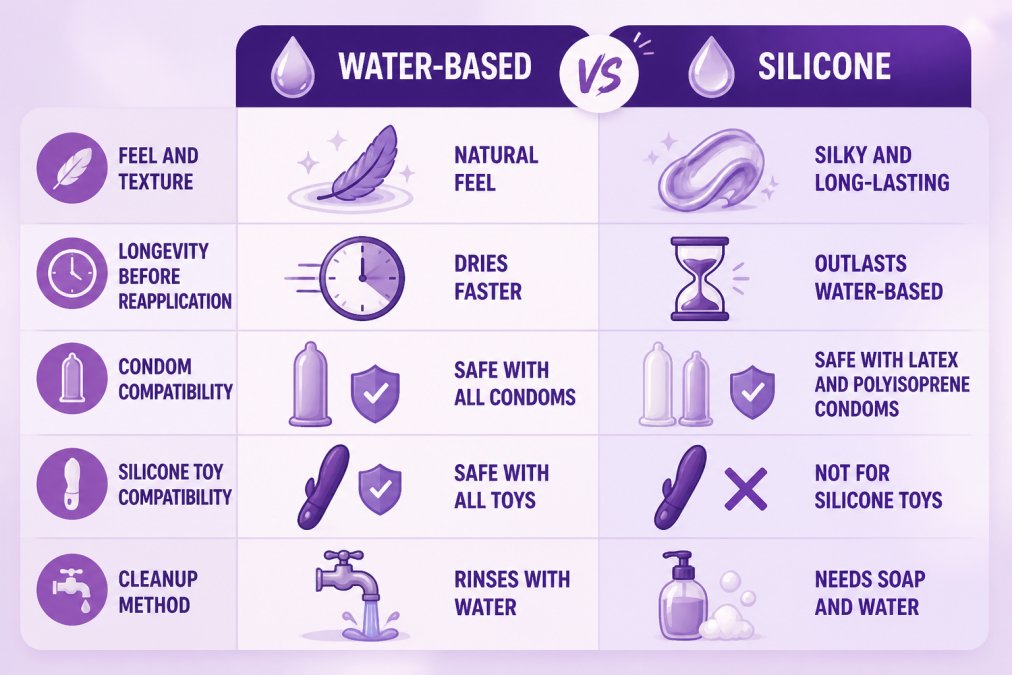
- Silicone toys: water-based or hybrid only
- Glass, metal, and ABS plastic toys: anything goes
- Latex and polyisoprene condoms: water-based or silicone-based
- Silicone toys plus silicone lube: don't
The Best Lubricant for Silicone Toys (Yes, It Exists)
The best lubricant for silicone toys is a water-based or hybrid formula, full stop. Silicone lube is the one thing you keep away from them.
Sensitive Skin, Stains, and Storage: The Stuff Nobody Tells You
This is the section most guides skip, and it's the one that generates the most 2 a.m. panic-Googling. Let's fix that.
Patch test like you mean it
Dab a dime-sized amount on your inner forearm, wait 24 hours, and check for redness, itching, or a warm tingle. Sounds fussy until you've spent a weekend itchy somewhere you can't scratch in public. If you're testing a new formula for vaginal or anal use, the forearm is a starting filter, not a final answer, some people react internally to things their arm tolerates fine.
Match the lube to the activity
This is where generic advice falls apart, because the "best" lubricant depends entirely on what you're doing:
- Vaginal use: water-based is the default, especially with condoms or toys. If you deal with dryness (perimenopause, menopause, certain medications, postpartum), a thicker water-based or a silicone formula holds up longer and doesn't get reabsorbed as fast.
- Anal use: the rectum doesn't self-lubricate, so you want something that stays put. Silicone-based is the workhorse here, it doesn't absorb, it doesn't dry out mid-session, and a little goes a long way. Water-based works too, but plan on reapplying. Never use numbing agents for anal play; pain is information, not an obstacle.
- Toy play: water-based or hybrid, always, if the toy is silicone. See the section above for why.
- Water play (shower, tub, pool): silicone-based only. Water-based rinses away in seconds.
- Post-menopausal dryness: thinner tissue and lower natural lubrication mean you want a formula without glycerin or propylene glycol, and one that stays slick rather than absorbing. Silicone-based formulas tend to be the gentler long-haul choice.
Stain removal, by fabric
Silicone lube leaves marks. Water-based usually doesn't. Here's how to handle both before they set:
- Cotton and linen sheets: blot immediately with a clean cloth, then work in a drop of dish soap with cold water. Wash on a normal cycle. Silicone stains that have already dried may need a second pass with dish soap before washing.
- Synthetic fabrics (polyester, microfiber): silicone clings harder. Blot, then treat with dish soap and cold water, and avoid hot water, heat can set the residue.
- Delicates and silk: skip the dish soap. Blot, then use a small amount of gentle laundry detergent and cold water, and air dry.
- Already washed and dried? You're not necessarily doomed. Re-treat with dish soap, let it sit 15 minutes, and wash again. Silicone is stubborn but not permanent on most fabrics.
Storage that doesn't ruin your investment
Keep bottles capped, upright, and out of direct sunlight. Heat degrades any lubricant's texture over time, and silicone formulas, while they don't expire quickly, can separate or thicken if left on a sunny windowsill. A cool, dark drawer is the move. Check the expiration date on water-based formulas especially; preservatives weaken over time, and a bottle that's been open for a year is a gamble.
Allergy testing without the drama
If you react to one formula, write down the ingredients before you try another. Glycerin, parabens, and propylene glycol are the usual suspects, but chlorhexidine and certain flavorings show up too. Bring the list to your gynecologist if reactions keep happening, pattern recognition beats guesswork.
Frequently Asked Questions
When should you not use silicone lubricant?
Skip silicone lubricant with silicone toys, since the silicone in the lube can degrade the silicone in the toy and leave it tacky or damaged. It is also worth avoiding if you want a lube you can rinse away with just water, or if you plan to use it with a toy you cannot fully wash. For silicone toy play, reach for a water-based or hybrid formula instead.
Can you use silicone lubricant with silicone toys?
No. Silicone lube and silicone toys are a bad match because the lubricant can break down the toy's surface over time, causing it to degrade, get sticky, or harbor bacteria. If your toy is silicone, choose a water-based option like Wicked Aqua or a hybrid like Wicked Hybrid, which is toy and latex friendly. Save the silicone formulas for body-only play.
Which is better for sensitive skin: water-based or silicone?
Silicone lubricants are often the gentler pick for sensitive skin because they contain fewer ingredients and no preservatives, so there is less to react to. Water-based formulas can work well too, but check the label for glycerin, parabens, and propylene glycol, which some people find irritating. If you are prone to irritation, patch test on your inner arm first and look for glycerin-free, paraben-free options.
Is glycerin safe for intimate health?
Glycerin is generally considered safe, but it is a sugar alcohol that some people find irritating or drying, and it can feed yeast, which matters if you are prone to infections. If you are sensitive or dealing with recurring yeast issues, a glycerin-free formula is the safer bet. Simply Timeless Silicone is free from glycerin, parabens, and propylene glycol, making it a solid choice for sensitive bodies.
What are the downsides of using water-based lubricant?
Water-based lubricant dries out faster than silicone, so you will need to reapply more often, especially during longer sessions. It can also get sticky as it evaporates and may leave a residue that needs a quick rinse. The trade-off is worth it for toy and condom compatibility, and formulas like Wicked Aqua stay slick longer than most thanks to aloe, Vitamin E, and olive leaf extract.
Choosing a lubricant shouldn't require a chemistry degree or a gamble on your favorite toy. The Flirty Femme curates lubricants and intimate wellness products with ingredient lists you can actually read, from glycerin-free silicone formulas to water-based options rich enough to fool you. Shop the collection and find your perfect match, with discreet shipping and bundles that make trying something new a lot less risky.