

How to Check for Safe Sensitive Ingredients (2026 Guide)
Table of Contents
- Why Your Skin Throws a Fit (and How to Read the Warning Signs)
- Ingredients to Avoid for Sensitive Skin: The Shady Characters List
- How to Read an INCI List Without Losing Your Mind
- How to Perform a Patch Test (Yes, Actually Do It)
- Skincare Ingredient Scanner Tools: Helpful or Hype?
- Budget-Friendly Safe Alternatives That Won't Break Your Skin or Bank
- How to Check for Safe Sensitive Ingredients in Intimate Products
- Conclusion
- Frequently Asked Questions
Last Updated: September 24, 2026
Why Your Skin Throws a Fit (and How to Read the Warning Signs)
Your skin has a memory. It remembers the glitter body oil from 2019, and the scented lotion that turned your thighs into a crime scene. Learning how to check for safe sensitive ingredients is how you stop adding new entries to that list.
Watch for these signs:
- Redness or blotchy patches that weren't there before
- Itching that gets worse, not better
- Dry, flaky, or peeling skin
- Burning or stinging when you apply something
- Small bumps or blisters
Ingredients to Avoid for Sensitive Skin: The Shady Characters List
The fastest way to protect reactive skin is knowing the repeat offenders. These ingredients to avoid for sensitive skin show up in more products than you'd think.
Fragrance, Preservatives, and the Usual Suspects
Fragrance is the number one troublemaker. Annoying part: companies don't have to tell you what's in it. "Fragrance" can hide dozens of chemicals behind one innocent word.
Other common irritants:
- Parabens (methylparaben, propylparaben) - preservatives that some people react to
- Phthalates - often hiding in fragrance blends
- Synthetic dyes (look for "FD&C" or "D&C" on labels)
- Surfactants like sodium lauryl sulfate, which strip your skin's natural oils
- Preservatives such as formaldehyde releasers
Cross-Reactivity: When One Allergy Invites Its Friends
This is the part most guides skip, and it's genuinely unfair.
How to Read an INCI List Without Losing Your Mind
The INCI list is the official ingredient list on every product label, International Nomenclature of Cosmetic Ingredients. It's the boring block of tiny text most people treat like terms of service: skim, scroll, hope for the best.
The Rules of the Road
Here's how the list actually works:
- Ingredients are listed by concentration, highest to lowest, until you hit the 1% mark
- Below 1%, order is basically a free-for-all, companies can list those however they want
- The first five ingredients usually make up the bulk of the formula
- Names are standardized globally, so "aqua" always means water and "tocopherol" always means vitamin E
- Botanicals get Latin names (Butyrospermum parkii = shea butter; Simmondsia chinensis = jojoba)
- Color additives can be listed in any order, and often appear as FD&C or D&C numbers
That 1% rule is the sneaky one. A preservative, fragrance component, or essential oil below 1% can legally sit near the bottom of the list, even if it's the exact thing your skin is furious about. Position tells you how much is in there, not how likely it is to bother you.
Decoding the Aliases
Half the battle is recognizing ingredients wearing disguises. A few common ones:
- "Fragrance" or "parfum", a catch-all that can legally hide dozens of individual compounds, including known allergens
- "Parfum" vs. "fragrance", same thing, different regional labeling convention
- "Alcohol denat.", denatured alcohol, often drying on reactive skin
- "Sodium laureth sulfate" vs. "sodium lauryl sulfate", the laureth version is generally gentler
- "Methylisothiazolinone" and "methylchloroisothiazolinone", preservatives that show up as long, unpronounceable strings; often abbreviated MIT and CMIT
The 15-Second Scan
Once you know the grammar, here's the fast pass:
- Check the top five for anything you already know you react to
- Scan for "fragrance" or "parfum" anywhere on the list
- Look for your personal red flags, the specific preservatives, dyes, or surfactants that have burned you before
- Note the length, a 15-ingredient list gives your skin fewer chances to object than a 50-ingredient one
You're not memorizing chemistry. You're learning to spot the five or six names that matter for your skin and ignoring the rest.
How to Perform a Patch Test (Yes, Actually Do It)
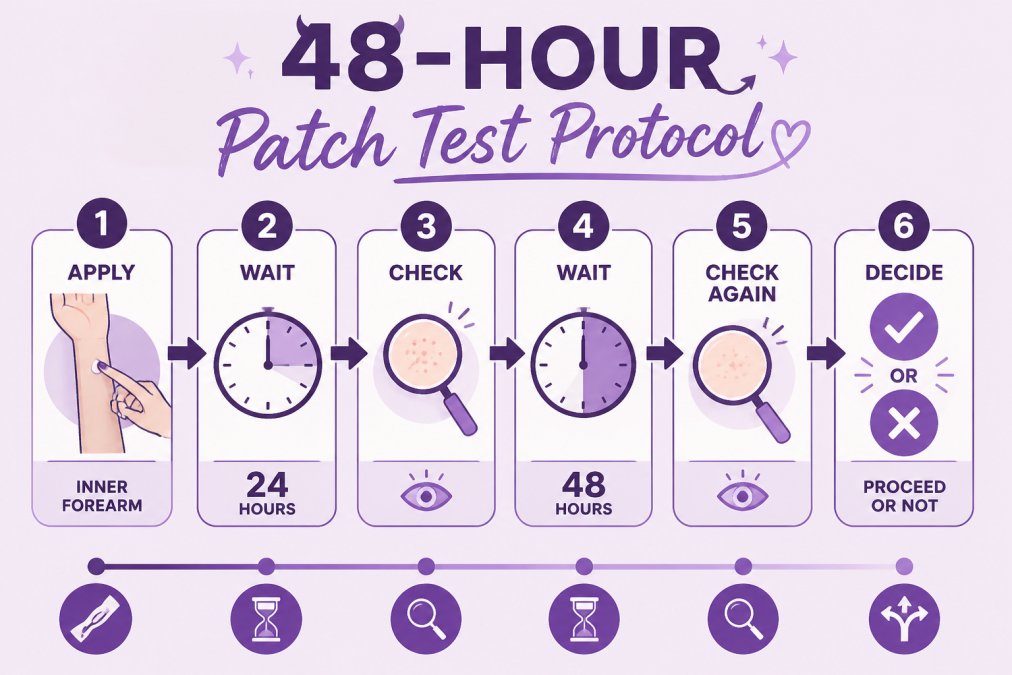
A patch test is a small-scale trial: apply a tiny amount of product to a small area and wait to see if it reacts. It takes two days. It saves you a week of misery.
The 48-Hour Patch Testing Protocol
Here's the full patch testing protocol:
- Clean a small patch on your inner forearm with plain soap and water
- Apply a dime-sized amount of the product to that spot
- Cover it with a bandage if you're worried about rubbing it off
- Wait 24 hours without washing the area
- Check for reaction: redness, itching, bumps, burning
- Wait another 24 hours and check again
- If no reaction, you're probably safe to use it elsewhere
Skincare Ingredient Scanner Tools: Helpful or Hype?
Skincare ingredient scanner tools are apps that scan a product barcode for an instant ingredient breakdown, flagging potential irritants, allergens, and comedogenic ingredients. Some assign a toxicity score or safety rating. A few straight-up tell you a product is "bad" in red letters, a fun thing to see mid-aisle.
What They Actually Do Well
- Save you from squinting at tiny text in a store aisle
- Flag common allergens fast
- Surface ingredients you'd never recognize on your own
- Help you build a personal "avoid" list over time
- Give you a starting point when you're overwhelmed by options
Where the Scores Get Sketchy
Here's what the apps don't tell you about their own ratings:
- Safety scores aren't standardized. Every app uses its own rubric, and two apps can rate the same product completely differently.
- "Clean beauty" scores don't equal "safe for your skin." A product can score perfectly and still contain the one preservative your face hates.
- Hazard ratings often reflect dose-agnostic concerns, meaning they flag ingredients based on worst-case scenarios rather than how they're actually used in a formula.
- They can't account for your personal sensitivities. Your skin's grudge list is unique. No database knows it.
- Some flag ingredients that are fine for most people, which trains you to fear things that were never going to bother you.
The Ingredient Anxiety Trap (and How to Climb Out)
This is the part nobody talks about. Scanner apps are designed to make you scan more, and scanning more makes everything feel dangerous. Red scores, warning icons, "avoid this" banners, a slot machine of low-grade dread that turns a moisturizer run into a 45-minute existential crisis.
A few ways to keep your head on straight:
- Pick one or two apps and stick with them. Cross-referencing five apps guarantees contradictory answers and zero peace of mind.
- Set your own rules before you scan. Decide what you actually avoid, say, fragrance and a specific preservative, and ignore everything else the app flags.
- Treat scores as information, not instructions. A yellow rating isn't a stop sign. It's a data point.
- Remember your skin is the final judge. No app has ever met your face. You have.
- If scanning starts feeling compulsive, put the phone down. A short ingredient list and a patch test will out-perform a panic spiral every time.
A Smarter Way to Use Them
Use scanner tools for what they're good at: speed and pattern recognition. Let them flag the obvious stuff so you can focus on ingredients that actually matter for your skin. Then verify with the label, patch test anything new, and keep a running note of what your skin has loved and loathed.
Budget-Friendly Safe Alternatives That Won't Break Your Skin or Bank
Sensitive skin doesn't require a luxury budget. Some of the gentlest options are the cheapest.
Look for products that are:
- Fragrance-free (not "unscented," which can still contain masking fragrances)
- Hypoallergenic (formulated to reduce reaction risk)
- Non-comedogenic (won't clog pores)
- Short ingredient lists with recognizable names
How to Check for Safe Sensitive Ingredients in Intimate Products
Intimate products need extra scrutiny. The skin down there is thinner, more absorbent, and less forgiving than your arm.
What to check:
- pH balance: intimate skin prefers slightly acidic formulas
- Glycerin content: high levels can disrupt natural balance for some people
- Fragrance: skip it entirely in this category
- Parabens and phthalates: avoid when possible
- Material safety: for toys, look for body-safe silicone or glass
Conclusion
The gap between "this looks nice" and "this won't wreck my skin" comes down to one habit: reading before you rub. Check the INCI list, patch test like you mean it, and skip anything hiding behind "fragrance."
Frequently Asked Questions
How can I check if ingredients are safe for my sensitive skin?
Start by reading the full INCI list, not just the marketing claims on the front of the package. Look for known irritants like synthetic fragrances, parabens, and phthalates. Then perform a patch test on your inner forearm before using anything on larger areas. Scanner tools and safety databases can help flag potential concerns, but they are guides, not gospel. Your own skin's reaction is the final verdict.
What does 'hypoallergenic' actually mean on a label?
Less than you think. The FDA does not regulate the term 'hypoallergenic,' so brands can slap it on almost anything. It suggests the product is less likely to cause reactions, but there is no standardized testing required. Treat it as a hint, not a guarantee. Always check the ingredient list and patch test, especially if you have reactive skin or a history of contact dermatitis.
How do I perform a patch test to check for skin sensitivity?
Apply a small amount of the product to your inner forearm or behind your ear. Wait 24 hours and check for redness, itching, or swelling. If nothing happens, wait another 24 hours and check again. Some reactions take up to 48 hours to appear. If you see a reaction at any point, wash it off and skip that product. This patch testing protocol applies to skincare, intimate products, and anything else touching your body.
Are there reliable apps to help me scan ingredient lists?
Several skincare ingredient scanner tools exist, and they can be useful for quick ingredient analysis. They pull from cosmetic safety databases and assign toxicity scores. The catch: their databases are not always complete, and they may flag ingredients that are fine for you personally. Use them as a starting point, then cross-check with dermatologist-recommended resources or your own patch test results.
Your skin deserves better than trial and error. Get started with The Flirty Femme and shop body-safe, fragrance-free options curated for sensitive skin.