

Safe Ingredients for Sensitive Intimate Skin: The 2026 Guide
Table of Contents
- Why Your Vulva Is a Drama Queen (And What It Needs)
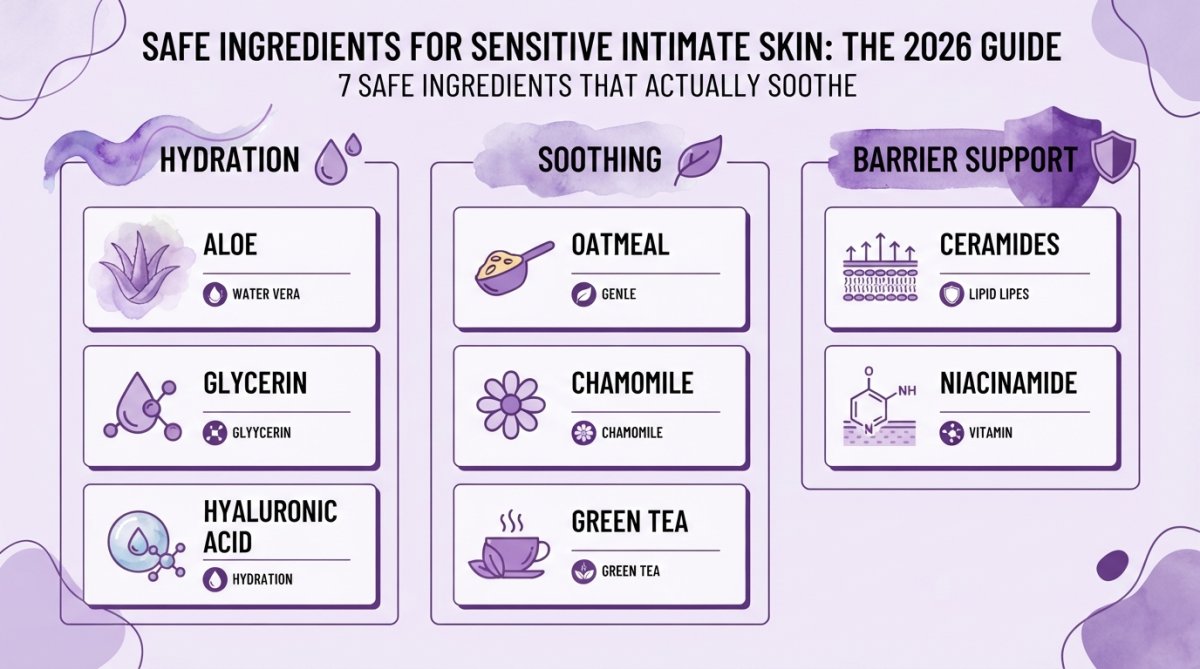
- The 7 Safe Ingredients for Sensitive Intimate Skin That Actually Soothe
- Ingredients to Avoid in Feminine Wash: The Rogue's Gallery
- Is Glycerin Safe for Intimate Health? The Sticky Truth
- How to Read a Label Like a Gynecologist (Without Med School)
- Your Intimate Care Cheat Sheet: Products We Love
- The Bottom Line on Safe Ingredients for Your Most Sensitive Skin
- Frequently Asked Questions
Last Updated: September 5, 2026
Down there is not the place for guesswork. Your vulva has skin that is thinner and more permeable than the rest of your body, absorbing whatever you put on it faster and reacting to irritants harder. Finding safe ingredients for sensitive intimate skin is about protecting the delicate ecosystem that keeps you comfortable and confident.
Most intimate discomfort isn't caused by some mysterious condition, it's caused by the products you're using. Contact dermatitis, that angry, itchy, inflamed feeling, is frequently a direct response to harsh chemicals hiding in "feminine" products. Below, we break down which ingredients soothe, which ones sabotage, and how to read a label like a pro.
Why Your Vulva Is a Drama Queen (And What It Needs)
Your vulvar skin is a diva with specific demands. Unlike the skin on your arm, it has a thinner stratum corneum, the outermost layer responsible for keeping moisture in and irritants out (peer-reviewed research). This makes it more susceptible to irritation, inflammation, and disruption of its natural pH balance, which typically sits around 3.5 to 4.5.
The goal isn't to scrub it clean; it's to maintain the skin barrier and support the good bacteria that live there. Think of your intimate area as a low-maintenance garden, it thrives when you leave it alone, but wilts if you douse it with harsh weed killer.
The 7 Safe Ingredients for Sensitive Intimate Skin That Actually Soothe
When your skin is throwing a tantrum, these are the peacekeepers. But here's where most articles drop the ball: they just list ingredients like a grocery list. We're going to explain the why and, more importantly, the who, because what works for your best friend's vagina might be a total buzzkill for yours.
The Dynamic Duos: Why Ingredient Synergy Matters More Than a Solo Act
Think of your intimate care routine like a cocktail. A single great spirit is nice, but the right mix creates something magical. Here’s how the power couples work together:
- Humectants + Occlusives (The Hydration Lockdown): Humectants like glycerin and hyaluronic acid are the thirsty sponges that pull water into the skin. But without an occlusive to seal it in, that moisture just evaporates. That's where ingredients like shea butter or squalane come in. They act as a bouncer at the club, keeping the hydration inside and the irritants out.
- Soothers + Barrier Supporters (The Calm & Fortify Combo): Colloidal oatmeal and chamomile are the emergency responders that calm the immediate redness and itching. But to prevent the next flare-up, you need to rebuild the wall. That's where ceramides and niacinamide step in. They're the construction crew that patches up the cracks in your skin barrier, making you less reactive over time.
The Microbiome Factor: It's Not Just About What You Put On, But What You Keep In
Here's the part most articles miss: your vagina is a bustling metropolis of good bacteria, mainly Lactobacillus. These hardworking microbes produce lactic acid and hydrogen peroxide, keeping the pH acidic (around 3.5 to 4.5) and warding off unwanted guests like yeast and bad bacteria (the NIH).
- Prebiotics & Postbiotics: The frontier of intimate care is moving beyond just 'gentle' to actively 'supportive.' Look for ingredients like alpha-glucan oligosaccharide (a prebiotic that feeds the good guys) or lactobacillus ferment (a postbiotic that helps maintain a healthy balance).
- The pH Balancing Act: A truly safe ingredient won't disrupt your natural acidity. Harsh soaps (even 'gentle' ones) can spike your pH, making you vulnerable to bacterial vaginosis (BV) and yeast infections. The best cleansers are formulated to a vaginal-friendly pH, typically around 4.0-4.5, ensuring they work with your microbiome, not against it.
The Full Roster: Your Ingredient Cheat Sheet
Here’s the breakdown of the seven safe ingredients, with a twist, we're adding the why and the who they're best for.
| Ingredient | Superpower | The 'Why' Behind the Magic | Best For |
|---|---|---|---|
| Glycerin | Hydration | A humectant that draws water into the skin's outer layer. In rinse-off products, it's a gentle, effective moisturizer. | Most people; avoid in leave-on products if you're prone to chronic yeast infections. |
| Aloe Vera | Soothing & Cooling | Contains polysaccharides and antioxidants that calm inflammation and provide a cooling sensation, perfect for post-activity or post-shave relief. | Anyone with redness, heat, or general irritation. |
| Hyaluronic Acid | Deep Hydration | Holds up to 1,000 times its weight in water, plumping the delicate skin and mucosa without a greasy residue. | Those experiencing dryness or micro-tears from friction. |
| Colloidal Oatmeal | Anti-Inflammatory | Finely ground oats that physically calm irritated skin, reduce itching, and help restore the skin barrier. A dermatologist favorite for eczema and contact dermatitis. | Anyone with active itching, rashes, or severe sensitivity. |
| Chamomile | Calming | Contains bisabolol and chamazulene, compounds with anti-inflammatory and soothing properties. | A gentle, natural soother for reactive skin. |
| Ceramides | Barrier Support | Lipids that act as the 'mortar' between skin cells, preventing moisture loss and keeping irritants out. | Those with a compromised skin barrier or chronic sensitivity. |
| Niacinamide | Barrier Strengthening | A form of vitamin B3 that boosts ceramide production, reduces inflammation, and helps build keratin for a stronger, more resilient barrier. | Those with chronic sensitivity, eczema, or looking for long-term skin health. |
The Age Factor: Your Skin Changes, So Should Your Routine
Here's a curveball most articles ignore: your intimate skin isn't static, it changes with your hormones.

- Reproductive Years: Your skin is thicker, more elastic, and your microbiome is a powerhouse of Lactobacillus. You can handle more active ingredients, but you still need to avoid harsh sulfates and fragrances that can disrupt your balance.
- Perimenopause & Menopause: As estrogen declines, your vulvar skin becomes thinner, drier, and less acidic. The Lactobacillus population dwindles, making you more prone to irritation and infection. This is when you need to double down on hydrating heroes like hyaluronic acid and glycerin, and barrier-supporting ceramides. Look for products that explicitly mention 'menopause-friendly' or 'for mature skin.'
Ingredients to Avoid in Feminine Wash: The Rogue's Gallery
Just as important as knowing what to look for is knowing what to run from. The ingredients to avoid in feminine wash are often the very things that cause the problem they claim to solve. If you see these on a label, put it down and back away slowly.
- Synthetic Fragrance and Parfum: This is a major culprit for contact dermatitis. Fragrance formulas can contain hundreds of undisclosed chemicals, many of which are known irritants and allergens (the FDA). "Fragrance-free" is your friend.
- Sulfates (SLS/SLES): These are harsh detergents that create foam but strip your skin of its natural oils, leaving it dry, tight, and vulnerable. Your vulva doesn't need a foamy lather like your dishes do.
- Parabens: Used as preservatives, parabens are controversial due to their potential as endocrine disruptors. Many brands now offer paraben-free formulas to avoid any risk.
- Drying Alcohols: Ingredients like SD alcohol or denatured alcohol evaporate quickly, which feels cool but actually sucks moisture out of your skin, disrupting the pH balance and leading to irritation.
Is Glycerin Safe for Intimate Health? The Sticky Truth
This is a hot topic, and the answer is nuanced. Is glycerin safe for intimate health? For most people, yes, especially in rinse-off products like washes, it's a gentle humectant that hydrates without clogging pores.
However, the concern arises with leave-on products, specifically lubricants. Glycerin is a sugar alcohol, and some research suggests that for individuals prone to recurrent yeast infections, a glycerin-based lube might feed the yeast and trigger an overgrowth. If you have a history of chronic thrush, you might prefer a glycerin-free, water-based option. The key is knowing your own body's sensitivities.
How to Read a Label Like a Gynecologist (Without Med School)
Reading an ingredient list shouldn't require a chemistry degree or a decoder ring. But it does require a bit of detective work, because the beauty industry loves to hide behind pretty packaging and vague terms.
The Golden Rule: Order Matters
The first and most important rule: ingredients are listed in descending order of concentration. The first five ingredients make up the bulk of the product. If a safe ingredient like aloe vera is listed dead last, there's barely enough to hydrate a gnat. If a scary chemical is listed second, it's a main character, not a cameo.

Decoding the Dirty Dozen: What to Run From
We've covered the obvious villains like sulfates and parabens. Here are the sneaky ones that often fly under the radar:
- The Fragrance Trap: This is the biggest offender. "Fragrance" or "parfum" on a label can legally hide hundreds of undisclosed chemicals, many of which are known allergens and irritants. A product can claim to be 'hypoallergenic' and still contain fragrance. "Fragrance-free" is your only true friend.
- The Preservative Paradox: Parabens get a bad rap, and many brands have removed them. But the replacements can be just as problematic. Look out for methylisothiazolinone (MIT) and methylchloroisothiazolinone (MCI), these are potent preservatives that are a leading cause of allergic contact dermatitis. A better option is phenoxyethanol, which is generally considered safer for sensitive skin.
- The pH Deception: A product can say "pH balanced" on the front, but balanced for what? Your skin's pH is around 4.5-5.5, but your vagina is more acidic at 3.5-4.5. A cleanser balanced for your face might be too alkaline for your vulva. Look for a product that specifically states it's formulated for the intimate area's pH (around 4.0-4.5).
The Green Angle: Safe for You, Safe for the Planet
Here's a twist most articles miss: what's safe for your most sensitive skin is often also what's safest for the environment. The chemicals that irritate your vulva, harsh sulfates, synthetic fragrances, certain preservatives, don't just disappear down the drain.
- Biodegradability Matters: Look for products with ingredients that are readily biodegradable. Plant-based cleansers derived from coconut or sugar (like coco-glucoside or decyl glucoside) are gentle on your skin and break down easily in the environment.
- The Microbiome Connection: Just as you want to protect your vaginal microbiome, you should care about the microbiome of our rivers and oceans. Ingredients that are antimicrobial (like triclosan, now largely banned in wash products) can wipe out beneficial bacteria in waterways.
Your Label-Auditing Checklist
Here's your quick-start guide for any product you pick up:
- The First Five: Look at the first five ingredients. Do you recognize them? Are they mostly water, a gentle cleanser, and a soothing agent? If the first ingredient is a harsh sulfate, put it down.
- The 'Free-From' List: Check the brand's website for a list of what they don't include. This is a good sign of transparency.
- Spot the Synergy: Don't just look for one hero ingredient. Look for the power couples we mentioned: a humectant (glycerin, hyaluronic acid) paired with a barrier supporter (ceramides, niacinamide).
- Check the pH: Look for "pH balanced" and then verify it's for the intimate area (around 4.0-4.5), not just general skin.
- Count the Ingredients: A shorter list is often a safer list. Fewer ingredients mean fewer chances for hidden irritants. If you can't pronounce it and it sounds like it belongs in a lab, it probably doesn't belong near your labia.
- Consider the Planet: Is the formula biodegradable? Are the surfactants plant-derived?
Your Intimate Care Cheat Sheet: Products We Love
Putting this knowledge into practice is easier with products that have already done the homework. We've curated a few favorites that follow all the rules we just talked about.
| Product | Key Safe Ingredients | Best For | Price |
|---|---|---|---|
| Simply Natural Aloe Vera Lubricant | Aloe Vera, Glycerin-free | Everyday glide, sensitive skin | $28.00 |
| Wicked Aloe Vera Lubricant | Organic Aloe, Sodium Hyaluronate | Prolonged play, extra cushion | $29.00 |
| After Vajay Play | Peppermint, Arnica | Post-intimacy soothing and cooling | $32.00 |
For a simple, clean glide that won't leave you guessing, the Simply Natural Aloe Vera Lubricant is your go-to. It's a water-based formula that is pH balanced, fragrance free, and free from glycerin and parabens, making it a fantastic choice for those with a sensitive skin barrier. If you want something with a bit more cushion for longer sessions, the Wicked Aloe Vera Lubricant uses organic aloe and sodium hyaluronate to keep things slick and hydrated without any sticky residue.
And for the after-party care your skin craves, the After Vajay Play gel is a game-changer. It's a soothing, pH-balanced aftercare gel designed to bring calm and relief to your most sensitive skin after any kind of high-intensity play.

The Bottom Line on Safe Ingredients for Your Most Sensitive Skin
Choosing safe ingredients for sensitive intimate skin comes down to one principle: gentle, simple, and pH-balanced. Your vulva isn't asking for a 10-step routine; it's asking you to stop sabotaging it with harsh soaps and mystery fragrances. By focusing on hydrating heroes like glycerin and aloe, calming botanicals like oatmeal and chamomile, and barrier supporters like ceramides, you're giving your skin exactly what it needs.
The challenge is that the market is full of products that promise freshness but deliver irritation. You need a source you can trust to skip the marketing fluff and get straight to the good stuff. The Flirty Femme takes the guesswork out of intimate wellness by curating a collection of high-quality, body-safe products that are as fun as they are functional.
Frequently Asked Questions
What do gynecologists recommend for feminine wash?
Gynecologists overwhelmingly recommend skipping dedicated feminine washes entirely. Your vulva is self-cleaning, so warm water is the gold standard. If you must use a product, look for a gentle, unscented, pH-balanced cleanser (around 4.5) with simple ingredients like aloe vera or glycerin. Avoid anything with synthetic fragrance, sulfates, or harsh detergents. Think of it like washing a cashmere sweater: you wouldn't use industrial-strength soap on it.
Is glycerin safe for intimate health and sensitive skin?
For most people, yes, but it's not a blanket yes. Glycerin is a humectant that draws moisture to the skin, making it a great hydrator in body products. However, in lubes or washes for those prone to yeast infections, glycerin can be a food source for candida. If you're sensitive or infection-prone, try a glycerin-free formula like the Simply Natural Aloe Vera Lubricant to see if your skin prefers it.
Are fragrance-free products always better for sensitive intimate skin?
Fragrance-free is almost always the safer bet for sensitive intimate skin. Synthetic fragrance is one of the most common causes of contact dermatitis in the vulvar area. It's a cocktail of dozens of undisclosed chemicals designed to smell pretty, not to be gentle on mucosa. Even 'natural' essential oils can be irritating. When in doubt, choose products with no scent listed on the label.
How can I tell if an intimate product will cause irritation?
Start by scanning the ingredient list for known irritants like synthetic fragrance, sulfates, parabens, and drying alcohols. If the label is vague, that's a red flag. Next, do a patch test: apply a small amount to your inner arm or behind your ear for 24 hours. If there's no reaction, try it on a small area of the vulva. A product that burns, stings, or itches is your skin telling you no.
Your skin barrier is your first line of defense, and it deserves better than synthetic fragrance and harsh detergents. Get started with The Flirty Femme and shop our curated selection of pH-balanced, gentle intimate care products designed to keep you comfortable, confident, and ready for anything.
This article was written using GrandRanker