

Why Intimacy Is Important for Health: 7 Benefits
Table of Contents
- Why Intimacy Is Important for Health: The Short Version
- The Health Benefits of Intimacy, Backed by Research
- Affectionate Touch, Hugging, and Why Your Brain Craves Bonding
- How to Build Intimacy With Your Partner (Without a Script)
- Communication About Intimacy: Consent, Boundaries, and Mismatched Desire
- Nonsexual Intimacy Ideas for Every Kind of Relationship
- When Intimacy Feels Hard: Health Conditions, Aging, and Professional Help
- Conclusion: Your Health Wants You to Get Close
- Frequently Asked Questions
Last Updated: October 12, 2026
Why Intimacy Is Important for Health: The Short Version
Your body keeps score of how often you feel close to someone, and the tally shows up everywhere from your blood pressure to your sleep quality. That's the honest answer to why intimacy is important for health: regular closeness, a long hug, a slow make-out session, a genuinely good conversation, nudges your nervous system toward calm and your mood toward steady.
Here's what most wellness content skips: intimacy isn't one thing. It's at least three, and they don't always travel together.
Emotional, Physical, and Sexual Intimacy Are Not the Same Thing
Emotional intimacy is the sense that someone actually knows you, your weird opinions, your bad days, your unfiltered thoughts, and stays anyway. Physical intimacy is affectionate touch: holding hands, leaning on a shoulder, a hand on the lower back. Sexual intimacy is the erotic piece, the part with the pulse.
You can have a marriage full of physical affection and zero sexual spark. You can have incredible sex with someone who has no idea what you're afraid of. Naming which kind you're missing changes how you fix it, a dry spell and a distance problem need different solutions.
The Health Benefits of Intimacy, Backed by Research
Here's what nobody puts on a greeting card: the research points in one consistent direction, but the strength of the evidence varies wildly by benefit. Some of it is solid.
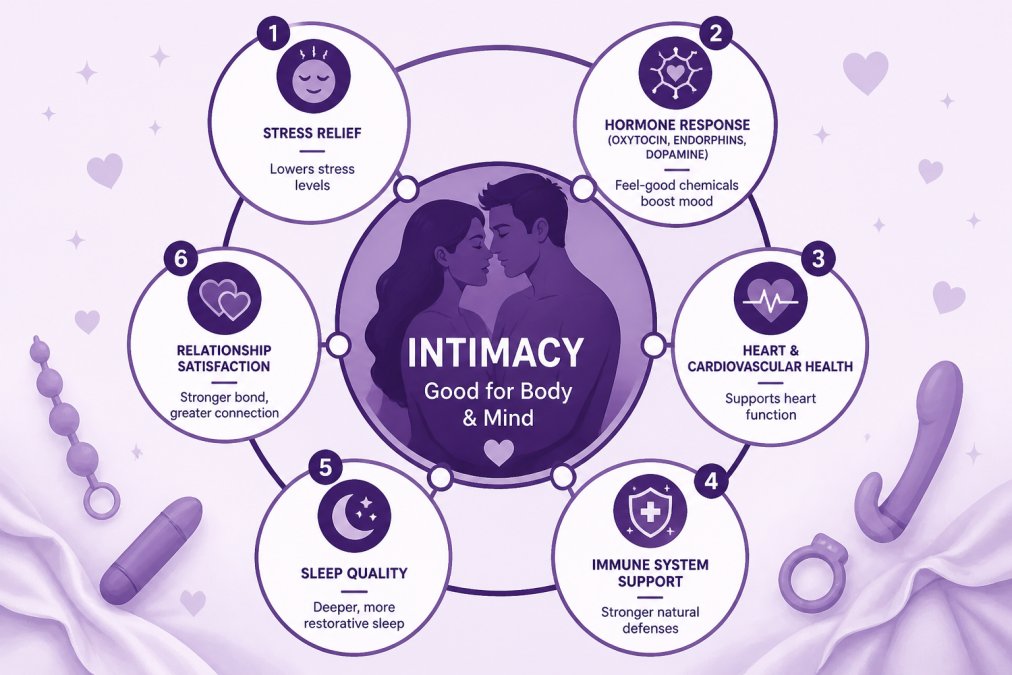
What the evidence does not support is the idea that you need a specific amount of sex per week to be healthy. Anyone selling you a number is selling you something.
1. Stress Relief and a Calmer Nervous System
Affectionate contact with a trusted partner shifts the body out of fight-or-flight. Your autonomic nervous system reads touch as a safety signal, your parasympathetic branch takes over, and breathing slows, heart rate steadies, muscles loosen, mental static quiets.
The catch is that this only works with someone you actually trust. A hug from a stranger doesn't do it, and neither does going through the motions with a partner you're currently furious at.
2. Feel-Good Hormones: Oxytocin, Endorphins, and Dopamine
This explains the "afterglow" people describe after good sex or a long cuddle. It's not imagination, it's a measurable shift in what's circulating in your body.

Worth knowing: the same chemistry fires during nonsexual touch. A long hug from a friend can produce a genuine oxytocin response.
One caveat: hormone research is tricky. Oxytocin is hard to measure reliably outside a lab, and many "cuddle hormone" claims come from small studies.
3. Heart Health, Immunity, and Better Sleep
Sex is physical activity, and it counts toward the cardiovascular movement your body wants. People in satisfying relationships also tend to show better heart health markers and stronger immune responses than people in chronically strained ones.
Here's where evidence quality matters. Much of the heart and immunity research is observational, it tracks patterns over time but can't prove intimacy caused the better outcomes.
Sleep is the clearest everyday win. Orgasms release tension and oxytocin, both of which make falling asleep easier.
Affectionate Touch, Hugging, and Why Your Brain Craves Bonding
Skin is your largest sensory organ, wired for connection from birth. A warm, sustained hug tells your brain you're not alone, and your brain dials down threat detection in response.
Hugging, hand-holding, and casual physical affection also do something less obvious: they maintain the bond between you and your partner in the background, without any deliberate effort. For more on how touch, closeness, and intimacy interact, the American Psychological Association's resources on relationships are a solid place to start.
How to Build Intimacy With Your Partner (Without a Script)
Intimacy gets built in small, unglamorous moments, not grand gestures. The couples who stay close kept doing tiny things: a hand on the back in the kitchen, eye contact a beat longer than necessary, a genuine "how was your day" with the phone face down.
Practical ways to build it:
- Protect 15 minutes of undistracted time daily. No phones, no logistics, no problem-solving. Just being in the same space together.
- Add touch that isn't a request. A shoulder rub with no expectation attached is a different signal than a shoulder rub that's a warm-up.
- Ask better questions. "What was the best part of your day" beats "how was work" every time.
Communication About Intimacy: Consent, Boundaries, and Mismatched Desire
Talking about intimacy is awkward for about 90 seconds, then it's the most useful conversation you'll have all month. Get explicit about three things: what you want, what you don't want, and what's changed.
Consent isn't a one-time box you check at the start of a relationship. It's an ongoing conversation, and it can be withdrawn at any point, by anyone, without justification. Boundaries aren't rejection; they're information.
The Difference Between Healthy Intimacy and Pressure
This is the part that matters most. Healthy intimacy has signatures: both people can say no without punishment, no one keeps a ledger of owed favors, and desire is expressed rather than extracted. Pressure looks like sulking after a no, "you used to be more fun," or sex that happens because saying no felt more expensive than going along. If that's familiar, name it out loud, and talk to a professional.
When You Want Different Amounts
Mismatched desire is the norm, not the exception. One person usually wants more sex than the other, and the ratio shifts over time, sometimes week to week. That's not a crisis by itself. It becomes one when it goes undiscussed and both people start keeping score.
A few things that actually help:
- Talk about it outside the bedroom, in daylight, without anyone's hand on anyone's thigh. Negotiating mid-arousal is a losing game.
- Separate desire from willingness. You can be willing to be intimate without feeling spontaneous desire, and that's a legitimate middle ground, as long as it's freely chosen.
- Name the real blocker. Often "I don't want sex" is actually "I'm touched-out," "I'm resentful about the dishes," or "I haven't slept in three days." Fix the blocker, not the symptom.
Scripts, Because Blank Stares Aren't a Strategy
If you've never said any of this out loud, borrow these:
- "I want more closeness, and I'm not sure sex is the only way to get it. Can we talk about what we both actually want?"
- "I'm not in the mood tonight, but I'd love to be close. Can we just cuddle?"
- "I've noticed we've been off. I'm not blaming you, I want to figure it out together."
Awkward? Yes. Effective? Also yes. The couples who talk about this stuff badly still do better than the ones who never talk about it at all.
Nonsexual Intimacy Ideas for Every Kind of Relationship
Intimacy isn't reserved for couples, and it isn't reserved for people having sex. Single, asexual, abstinent, long-distance, or just in a dry spell, the same principles apply: closeness is a practice, not a status.
Nonsexual intimacy ideas that actually work:
- Cook something together and split the tasks, no one directing traffic.
- Take a walk with no destination and see where the conversation goes.
- Read the same book and argue about it.
None of these require a partner in the romantic sense. A close friend, a sibling, a chosen family member can all be intimacy partners in the ways that matter for health.
When Intimacy Feels Hard: Health Conditions, Aging, and Professional Help
Sometimes intimacy gets hard for reasons that have nothing to do with the relationship. Chronic pain, disability, menopause, erectile difficulties, medication side effects, depression, and anxiety all affect desire and physical comfort, and none of them mean intimacy is over.
Aging changes things too, but it doesn't remove the need for closeness. Many people find that intimacy in later life looks different and feels better, partly because the performance pressure drops.
A few things that help when the body or mind is getting in the way:
- Talk to your doctor about medication side effects. Some drugs blunt desire or arousal, and there are often alternatives.
- Adjust the mechanics. Different positions, more lube, more time, more focus on sensation over outcome.
- Consider a pelvic floor trainer. The Connect Kegel Exerciser combines pelvic floor strengthening with 9 vibration functions, app control, and body-safe silicone, and it's designed to be used alone or with a partner.
- Add a daily supplement if stress is the bottleneck. Our Dame Desire Gummies are doctor-formulated with adaptogens like Sensoril Ashwagandha and L-theanine, and in a clinical trial, 85% of participants reported an increase in sexual desire and satisfaction.
Conclusion: Your Health Wants You to Get Close
Intimacy is one of the few health habits that feels like a treat and works like maintenance. The evidence supports the broad claim (closeness helps), not the narrow one (hit a specific quota). What matters is consistency, communication, and giving yourself permission to want it.
If you're ready to invest in that side of your life, we've built a collection for exactly this. Our Euforia water-based lubricant with hyaluronic acid and our Nourishing Drops for daily intimate skin care are two of our most-loved starting points, and our curated bundles make it easy to try more than one thing at once.


Shop All at The Flirty Femme.
Frequently Asked Questions
Why is intimacy important in a relationship?
Intimacy is what separates a romantic relationship from a roommate situation with shared bills. It covers emotional closeness, physical affection, and sexual connection, and research links all three to higher relationship satisfaction and better individual well-being. Couples who maintain affectionate touch, honest communication, and mutual understanding tend to report stronger bonds and lower stress than those who let closeness slide. It also works in reverse: a healthy relationship makes intimacy easier to sustain, so the two feed each other.
Can a relationship survive without physical intimacy?
Yes, but it depends on what both people want. Some couples thrive with little or no sexual activity, especially when emotional closeness, affection, and communication stay strong. Others find that a long stretch without touch breeds resentment, distance, or mismatched desire. The deciding factor is not a magic frequency. It is whether both partners feel heard and satisfied with what they have. If one person is quietly miserable, that is the signal to talk, not to keep score.
How can you build intimacy without having sex?
Plenty of nonsexual intimacy ideas do the heavy lifting: lingering hugs, holding hands, scalp massages, cooking together, sharing a bath, or trading honest answers to questions you have never asked. Daily rituals like a six-second kiss before work or phones-down cuddling at night build bonding through affectionate touch and attention. These habits keep emotional closeness alive during illness, stress, or dry spells, and they often make sexual intimacy easier to return to later.
How can you talk to your partner about wanting more intimacy?
Pick a neutral moment, not the middle of a fight or right after a rejection. Lead with what you want more of rather than what your partner is doing wrong: "I miss feeling close to you, and I want to figure out how we get that back." Ask what they need too, since mismatched desire usually runs both directions. If the conversation keeps stalling or one of you feels dismissed, a licensed couples therapist can help. Communication about intimacy is a skill, not a personality trait.