

Is Coconut Oil Safe for Intimacy? The Honest Answer
Table of Contents
- The Short Answer: Is Coconut Oil Safe for Intimacy?
- Coconut Oil vs Water-Based Lubricant: The Real Difference
- The Latex Condom Problem Nobody Warns You About
- Your Vaginal pH, Flora, and the Infection Risk
- Is Glycerin Safe for Intimate Health? What You Need to Know
- Skin Sensitivity, Allergic Reactions, and How to Test Safely
- Post-Coital Hygiene and Aftercare That Actually Helps
- Conclusion: What to Reach For Instead
- Frequently Asked Questions
Last Updated: September 27, 2026
The Short Answer: Is Coconut Oil Safe for Intimacy?
Yes, coconut oil is generally safe for intimacy, with some very real caveats. The coconut oil safe crowd isn't wrong about the glide, the scent, or the price. They're just quiet about the condoms it destroys and the pH it can throw off.
This guide from The Flirty Femme breaks down what's actually happening down there when you reach for the jar in your kitchen. Below, we'll cover the condom problem, the infection risk, the refined-versus-unrefined debate, and what to reach for instead. But first, here's what most guides get wrong: they treat "natural" and "safe" as the same word. They aren't.
The CDC's guidance on sexual health and condom use is clear that oil-based products and latex don't mix, and that's the single biggest reason to think twice.
Coconut Oil vs Water-Based Lubricant: The Real Difference
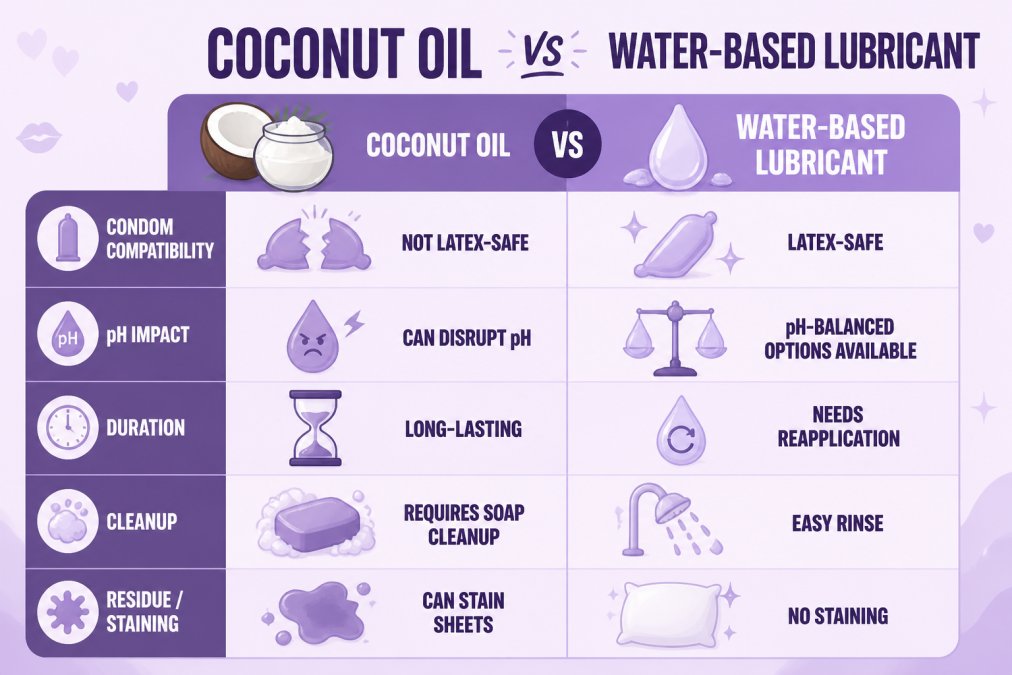
Coconut oil and water-based lubricant solve the same problem in opposite ways. Coconut oil is an oil-based lubricant: it stays slick for a long time, doesn't evaporate, and doubles as a moisturizer. Water-based lubricant is formulated to be compatible with latex condoms and pH-balanced for mucous membranes. Each wins in different scenarios.
Where Coconut Oil Wins
Longevity, texture, and cost. A little goes a long way, and it doesn't get tacky the way some water-based formulas do. It's also a genuinely good moisturizer for outer skin, which is why so many people love it for massage that transitions into play. The moisturizing properties are real.
Where Water-Based Wins
Compatibility and predictability. A quality water-based lubricant works with latex condoms, washes off with water, and won't leave residue on your sheets. If you want a lubricant you don't have to think about, this is it. For a coconut-oil option that's been elevated with skin-loving Vitamin E and shea butter, [our Coconut Oil Lubricant is built for exactly this](/products/wicked-coconut-oil-lubricant).

The Latex Condom Problem Nobody Warns You About
Coconut oil breaks down latex. Full stop. Oil-based lubricant degrades the latex in condoms within minutes, which raises the risk of condom breakage and turns your barrier method into a decoration. If you're relying on condoms for pregnancy or STI protection, coconut oil is not your lubricant.
This applies to latex only. Polyurethane and polyisoprene condoms aren't damaged by oil the same way, but most people don't check the box before reaching for the jar.
Your Vaginal pH, Flora, and the Infection Risk
Vaginal pH sits in a mildly acidic range, and that acidity is what keeps vaginal flora in balance. Coconut oil is not pH-balanced for the vagina. Introducing an alkaline substance can disrupt that environment, and disruption is how bacterial vaginosis and yeast infections get a foothold.
Does that mean every coconut oil encounter ends in an infection? No. Plenty of people use it without issue. But if you're prone to BV or yeast infections, coconut oil is a gamble, and the odds aren't in your favor. The NIH overview of bacterial vaginosis explains how quickly vaginal flora can shift when the environment changes.
There's also the biofilm question. Biofilm is a sticky layer of bacteria that clings to surfaces, and oil residue can create a friendly environment for it. If you're not cleaning up thoroughly, you're leaving a welcome mat out.
Refined vs. Unrefined: Does It Matter?
For intimacy, unrefined (virgin) coconut oil is the better pick. Refined coconut oil goes through processing that can strip some of its natural compounds, and it sometimes carries additives. Unrefined keeps more of the original oil intact.
That said, neither version is pH-balanced, so the refined-versus-unrefined distinction matters less than the condom and infection questions. It's a detail worth knowing, not a dealbreaker.
Is Glycerin Safe for Intimate Health? What You Need to Know
Glycerin is a humectant, which means it pulls moisture toward the skin. It's common in water-based lubricants and intimate wipes, and for most people, it's fine. The concern is that glycerin is a sugar alcohol, and some research suggests it can feed yeast, which matters if you're prone to yeast infections.
Is glycerin safe for intimate health? For most people, yes. If you have a history of recurrent yeast infections, it's worth checking labels and choosing glycerin-free or preservative-free options. Our Sweetums Intimate Flavored Wipes list glycerin right on the label, so you know exactly what you're getting.

Skin Sensitivity, Allergic Reactions, and How to Test Safely
Patch-test before you commit. Coconut oil allergies are uncommon but real, and the last place you want to discover one is mid-encounter. Here's how to test any new intimate product safely:
- Apply a small amount to the inside of your forearm
- Wait 24 hours and check for redness, itching, or swelling
- If clear, apply a small amount to the outer vulva
- Wait another 24 hours before using it during intimacy
- Stop immediately if you feel burning, stinging, or irritation
An allergic reaction can show up as irritation, swelling, or a rash, and it can take hours to appear. Testing on your arm first gives you a low-stakes trial run. Dermatological reactions to coconut oil are more common in people with existing skin sensitivities, so if your skin is reactive in general, test carefully.
Post-Coital Hygiene and Aftercare That Actually Helps
Oil doesn't rinse off the way water-based lube does. It clings. It lingers.
Here's the protocol, in order:
1. Pee within 15-30 minutes. This is the one piece of aftercare advice that applies to basically everyone with a urethra. Urinating flushes bacteria out of the urethra before it can set up shop, which is why it's the standard recommendation for reducing urinary tract infection risk after sex. It has nothing to do with the coconut oil specifically, it's just good hygiene, oil or no oil.
Conclusion: What to Reach For Instead
Coconut oil is safe for intimacy in the right context, and a liability in the wrong one. If you're not using latex condoms and you're not infection-prone, it's a lovely, long-lasting option. If either of those applies to you, a pH-balanced or water-based formula is the smarter reach.
Frequently Asked Questions
Is coconut oil compatible with latex condoms?
No. Oil-based lubricants like coconut oil break down latex within minutes, which can cause condom breakage and leave you unprotected. If you're using latex condoms, stick with water-based or silicone-based lubricant. For internal condoms and polyurethane condoms, coconut oil is generally considered safe since those materials aren't degraded by oil. When in doubt, check the condom packaging or switch to a water-based formula to keep your barrier methods intact.
Does coconut oil affect vaginal pH balance?
Coconut oil is alkaline, while a healthy vaginal pH sits between 3.8 and 4.5 (acidic). Using coconut oil internally can disrupt that balance, potentially allowing harmful bacteria to multiply and increasing your risk of bacterial vaginosis or yeast infections. The effect varies by person, but if you're prone to infections or have a sensitive microbiome, coconut oil is a gamble. A pH-balanced, clinically formulated lubricant is the safer bet for internal use.
Can I use coconut oil on my private parts without irritation?
Many people can use coconut oil externally on the vulva without issues, thanks to its moisturizing properties. But sensitive skin can react to anything, including natural oils. Do a patch test first: rub a small amount on your inner forearm and wait 24 hours. If there's no redness, itching, or burning, try a tiny amount on the vulva. If you notice irritation, stop immediately. For anyone with a history of allergic reactions or dermatological sensitivities, a preservative-free, pH-balanced product designed for intimate skin is a smarter choice.
Is coconut oil safe for anal play?
Coconut oil can work as a lubricant for anal play because it lasts longer than water-based options and the anus doesn't have the same pH concerns as the vagina. However, the latex condom rule still applies: never use coconut oil with latex barriers. Also, coconut oil isn't compatible with silicone toys if you're using them anally, since oil can degrade silicone over time. For anal play, a thick silicone-based lubricant is often the better pick because it stays slick and is safe with condoms and toys.
Which coconut oil is best for intimacy if I really want to try it?
If you're set on coconut oil, choose unrefined, cold-pressed, organic coconut oil with no added fragrances or preservatives. Unrefined oil retains more of its natural moisturizing properties, but it also has a stronger coconut scent and may contain more potential allergens. Refined coconut oil is more processed but less likely to trigger reactions. Either way, keep it external only if you're worried about pH, and never pair it with latex condoms. For a ready-made option that combines coconut oil with skin-loving ingredients, a coconut oil-based lubricant balm can be a more elegant choice.
The gap between "natural" and "safe" is where most people get into trouble. Coconut oil has real benefits and real risks, and the smart move is picking a product that accounts for both. At The Flirty Femme, we stock lubricants, aftercare gels, and intimate wipes formulated for pH balance, condom compatibility, and skin comfort, so you're not guessing. Get started with The Flirty Femme and build an intimate routine that feels as good as it is safe.