

How to Find the G-Spot for Beginners in 2026
Table of Contents
- What You'll Need Before You Go Hunting
- Where Exactly Is the G-Spot? (Hint: It's Not a Magic Button)
- Step-by-Step: How to Find the G-Spot Solo
- Best Positions for G-Spot Stimulation (Solo and Partnered)
- Using Sex Toys for G-Spot Exploration
- The Benefits of Using Water-Based Lubricant
- How to Communicate With a Partner About Pleasure
- Common Mistakes and What to Do When You Can't Find It
- Frequently Asked Questions
Last Updated: October 2, 2026
What You'll Need Before You Go Hunting
Learning how to find the G-spot for beginners 2026 starts with one truth: it's less about a hidden treasure map and more about slowing down. At The Flirty Femme, we hear from plenty of people who've poked around, felt nothing, and decided the whole thing is a myth.
Here's your starter kit:
- Time. No rushed five-minute mission. Set aside 20-30 minutes.
- Water-based lubricant. Non-negotiable. More on this below.
- Clean hands with short, filed nails.
- A relaxed body. Tense muscles hide everything.
- Zero pressure. Curiosity, not a to-do list.
The biggest mistake beginners make is treating this like a race. It's a wander, not a sprint.
Where Exactly Is the G-Spot? (Hint: It's Not a Magic Button)
Here's the part where we save you from a lot of frustrated poking: the G-spot is not a button, a bean, or a secret trapdoor. It's a region, a zone of sensitive tissue on the front (anterior) wall of the vaginal canal, roughly 2-3 inches inside, sitting behind the pubic bone and wrapping around the urethra.
That's the map. Now here's the plot twist.
The Anatomy Behind the Hype
The term "Gräfenberg spot" comes from a German gynecologist, but modern anatomy texts describe the area as part of a larger internal structure often called the clitoral complex, the internal roots and bulbs of the clitoris that extend back into the body.
The tissue itself is often linked to the Skene's glands (also called the paraurethral glands), which sit near the urethra and can swell with arousal.
Why Yours Might Be Somewhere Slightly Different
This is the part nobody tells beginners, and it's the reason so many people give up: anatomy varies. A lot.
- Depth varies. Some people feel it at about an inch in; others need to reach closer to three.
- Side varies. It can sit slightly left or right of center, not dead-center on the wall.
- Intensity varies. Some people describe fireworks. Some describe pressure. Some describe a vague urge to pee. Some feel nothing distinct at all.
- Presence varies. Not everyone has an obvious, easily located sensitive patch, and that is a normal variation, not a defect.
A common pattern is that the area becomes more noticeable with arousal, because increased blood flow plumps the tissue. Translation: hunting for it cold is like looking for a light switch in the dark with the breaker off. Get turned on first, then go exploring.
The Cleveland Clinic's guide to the G-spot is a solid, no-nonsense reference if you want the clinical version of everything above.
The Myth You Can Retire Right Now
If you've heard the G-spot is a myth because some study couldn't find it on an ultrasound, here's the nuance: researchers debate the label, not the sensation. Plenty of people reliably feel intense pleasure from internal front-wall stimulation. Whether we call that a "spot," a "zone," or part of the clitoral complex is a naming argument. Your nerve endings don't care what the textbook calls them.
Step-by-Step: How to Find the G-Spot Solo
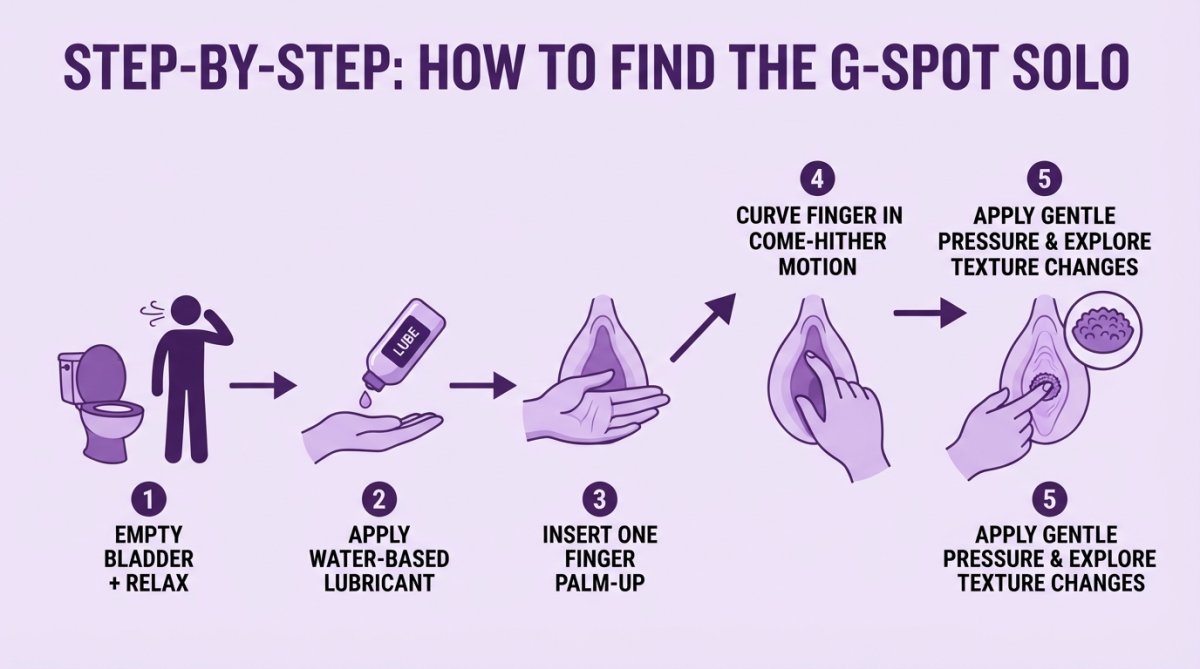
The best way to find the G-spot is to explore alone first, so you know what you're working with before inviting anyone else along.
- Empty your bladder and relax. A full bladder muddies the sensation.
- Apply water-based lubricant generously to your fingers.
- Insert one finger, palm up. Lie on your back with knees bent.
- Curve your finger in a "come-hither" motion toward your belly button.
- Press gently and explore. Feel for a patch that's slightly textured or spongier than the smooth walls around it.
What It Feels Like When You're Close
Many people describe a swelling, a fullness, or a tingle that builds. Some feel a sudden urge to urinate, which usually means you're in the right neighborhood. Breathe through it. That pressure often melts into pleasure once your body relaxes.
Best Positions for G-Spot Stimulation (Solo and Partnered)
Angle is everything when you're chasing internal pleasure. The best positions for G-spot stimulation tilt the pelvis so the front wall gets attention.
- Solo: On your back, knees bent, feet flat. Or one leg raised.
- Partnered, missionary with a pillow: A wedge under the hips changes the angle fast.
- Doggy style: Lets a partner curve upward toward the front wall.
- Cowgirl: You control the angle and the pace.
The magic ingredient is a slight upward curve toward the belly. If a position isn't working, shift your hips an inch and try again.
Using Sex Toys for G-Spot Exploration
Using sex toys for G-spot exploration takes the guesswork out of angles. A curved toy does the reaching for you.
The Nu Sensuelle Libi G-Spot Vibrator has an ultra-flexible shaft and a bulbous head designed to hit hard-to-reach internal spots, no matter how your curves run.
Nu Sensuelle Libi G-Spot Vibrator →
A quick comparison:
| Toy | Shape | Best For | Standout Feature |
|---|---|---|---|
| Nu Sensuelle Libi | Flexible shaft, bulbous head | Reaching tricky angles | XLR8 turbo boost |
| Manto | Curved, rounded silicone | Gentle internal massage | Swipe touch panel |
| Euforia V39 | Contoured, heated | Warmth lovers | Caleo heating tech |
Start on the lowest setting. Vibration plus pressure can tip you from "hmm" to "oh" faster than you expect.

The Benefits of Using Water-Based Lubricant
The benefits of using water-based lubricant go way beyond comfort. Friction kills sensation. When tissue is dry, your nerves read "ouch" instead of "ooh," and your brain shuts the whole operation down.
Water-based lube is the safest pick for beginners because it:
- Plays nice with silicone toys and condoms
- Washes off easily
- Feels natural, not sticky
- Works with sensitive skin
A stimulating gel can add a tingle on top. The Orgasm Rainfall G-Spot Stimulating Gel is a water-based formula with a hot-cold effect, made with 97% natural-origin ingredients and dermatologically tested.
How to Communicate With a Partner About Pleasure
How to communicate with a partner about pleasure comes down to one move: say what feels good in the moment, not after.
Try phrases like:
- "A little slower."
- "More pressure, right there."
- "Curve up toward my belly."
- "That's it, keep going."
You're not delivering a critique. You're giving directions, like a co-pilot. Most partners are relieved to have a map instead of guessing.
Common Mistakes and What to Do When You Can't Find It
If you can't find the G-spot, congratulations, you're in the majority on the first few tries. Here's what usually goes sideways, plus the mental game nobody warns you about.
The Mechanical Mistakes
- Too much pressure, too fast. The front wall is sensitive tissue, not a stubborn jar lid. Slow down and lighten up before you go harder.
- No lube. Dry friction numbs everything and turns "ooh" into "ouch." Water-based, every time.
- Thrusting instead of pressing. Fast in-and-out motion skips right past the spot. Steady, rhythmic pressure on one area is what actually builds sensation.
- Hunting instead of relaxing. Anxiety tightens the pelvic floor muscles, which literally pulls the tissue you're trying to reach into a less accessible position.
- Giving up after one session. It can take several tries to tune in, especially if you're learning your own anatomy for the first time.
The Real Culprit: Performance Anxiety
Here's the gap most guides leave wide open. The biggest obstacle for beginners isn't technique, it's the voice in your head asking, "Am I doing it right? Is it supposed to feel like this? Why isn't it working?"
That voice is a mood killer, and it's not a character flaw. It's your nervous system doing its job. When you're mentally monitoring yourself like a lab experiment, your body reads the tension as a threat and clamps down.
A few things that actually help:
- Reframe the goal. You're not "finding" anything. You're exploring and noticing. Sensation is the win, not a destination.
- Drop the timeline. If it takes five sessions or fifty, that's information, not failure.
- Breathe into your pelvic floor. Slow exhales relax the muscles that anxiety tightens.
- Try it when you're already aroused, not as a cold-start mission. Arousal does half the work for you.
- Take the pressure off orgasm entirely. Pleasure without a finish line is still pleasure.
When It's Just Not Your Thing
Some people never feel much from internal stimulation, and that is completely fine. Clitoral stimulation alone is a valid, satisfying path to pleasure. Bodies vary, nerve endings vary, and pleasure isn't a test you can fail. If you've given it a genuine, relaxed try and it's not your jam, you've learned something useful about yourself, that's a win, not a loss.
Beginners who enjoy G-spot play the most aren't the ones with "perfect" anatomy. They're the ones who dropped the scorecard, got curious, and let sensation lead instead of a checklist.
Frequently Asked Questions
How many inches do you need to hit the G-spot?
Most people find the G-spot about 2 to 3 inches inside the vaginal canal on the anterior wall (the side facing your belly). You don't need length to reach it. A single finger, a curved toy, or a partner's fingertip can get there. The key is angle and pressure, not depth. If you're using a toy, look for one with a curved shaft designed for internal massage, like the Manto G-Spot Toy, which is shaped to reach comfortably.
Do I need a partner to find my G-spot?
Not at all. Solo exploration is actually the best starting point because you control the pressure, rhythm, and angle without any performance pressure. Lie down, relax your pelvic floor muscles, use plenty of water-based lubricant, and take your time. Once you know what works for your body, you can guide a partner with confidence. Many people find solo exploration with a curved toy or their own fingers more effective for locating the G-spot than partnered play at first.
Is it normal if I can't find my G-spot?
Completely normal. Research shows the G-spot isn't a universal structure. Some people have sensitive tissue in that area, others don't respond to internal stimulation at all, and that's not a problem. Your pleasure doesn't depend on finding one spot. Clitoral stimulation, arousal phase, and overall intimacy matter just as much. If internal exploration isn't doing it for you, try combining clitoral stimulation with gentle internal pressure. And if it's still a no, that's your body's answer, not a failure.
What role does lubrication play in G-spot exploration?
Lubrication is non-negotiable for comfortable internal exploration. The vaginal canal doesn't always produce enough natural lubrication, especially during the early arousal phase or if you're feeling nervous. A water-based lubricant like the Orgasm Rainfall G-Spot Stimulating Gel reduces friction, makes fingertip pressure smoother, and lets you focus on sensation instead of discomfort. Water-based formulas are also safe with silicone toys and easy to clean up. Apply generously and reapply as needed.